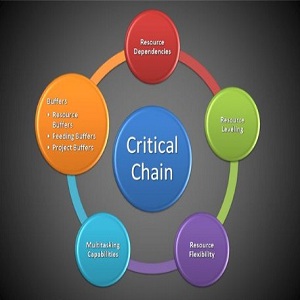
Understanding Critical Chain Project Management MethodologiesWhat is Critical Chain Project Management? Critical Chain Project Management (SCPM) offers a holistic approach to projects by viewing projects as part of a larger system instead of being isolated tasks. Using Critical Chain Project Management, groups and departments to shift their focus from completing tasks to ensuring only the end result and deadline matter. According to Christopher Freville, author of Metaling Metrics, this new approach helps deliver better service, which result in better customer satisfaction, and ultimately better business results. In this article, we will describe the basics of this new approach and how it can help organizations.
There are several components to what is known as the critical chain project management approach, which includes scheduling, assignment, execution, reviews, and follow-ups. When these four elements are combined, the effect is an efficient project team that meets its goals and deadlines. The basic idea behind this method of working is that there are four separate but interconnected cycles that drive the project. The first cycle is the Planning/Negotiation stage. During this time, key stakeholders are discussed and negotiations take place with the key contractor, resulting in a contract and agreement to execute the task.
The second cycle is known as the Execution phase. This is where the team commits to the tasks that are being assigned. At this point, tasks are reviewed and approved, and any necessary modifications are made to the scope. Once these modifications are made, the task is entered into the production phase. Within the production phase, the critical chain project management protocol is used to ensure the task is executed as specified and to ensure all necessary stages and steps are followed, from planning, implementation, reviews, to post-production.
The next phase is known as the Contingency Phase. In this phase, project team members continue to review and approve the schedule, changes, and tasks in order to make sure the project remains on schedule and within budget. If there are any unforeseen issues or problems, the methodology will be modified accordingly. The methodology ensures that if any problems occur, they are resolved in a timely manner, reducing the risk of negative impact to the company.
Lastly, the last phase is known as the Control phase. This is often referred to as the safety time. The control phase ensures that the tasks are programmed correctly and are not being changed due to unforeseen issues. Projects that utilize this methodology are often successful, as projects that use traditional methods of project management often result in delays and problems with deadlines.
Projects that employ the Critical Supply Chain skills Project Management frameworks and techniques to reap the benefits of using proven methods that yield maximum results. These methodologies include four frameworks with five additional frameworks. Some other frameworks include; Lean Manufacturing, Six Sigma, Kaizen Events, Lean Enterprise, and Kanban. These frameworks provide project managers with the ability to create a highly functional and efficient project management process.
About This Author | Scott Johnny
Hi, i am Johnny Scott and i am professional content writer.
Joined: November 18th, 2020
|
|
Article Directory /
Arts, Business, Computers, Finance, Games, Health, Home, Internet, News, Other, Reference, Shopping, Society, Sports
|